

In research design, there’s a familiar moment. A study is scoped, objectives are aligned, and the approach is sharp. Then someone asks a seemingly harmless question: Can we just add one more thing?
The request rarely feels unreasonable. In fact, it’s often well-intentioned. Running research is expensive, time-consuming, and resource-intensive. If the audience is already recruited and the study is already underway, why not layer in a few additional questions? Why not take advantage of the opportunity?
That instinct, while understandable, is where studies begin to drift.
Why “a little more” creeps in
The push to expand research objectives often comes from rational places. Teams are trying to be efficient, responsible, even creative.
Cost efficiency is one of the most common drivers. Running a single study feels more economical than funding multiple efforts. If two stakeholders have different questions, combining them into one research stream can appear to reduce redundancy and maximize return on investment.
There’s also the reality that some questions never rise to the level of needing their own dedicated study. They sit just below the threshold. They’re interesting and potentially useful, but not critical enough to warrant standalone attention. Folding them into an existing study becomes the only practical way to get any answer at all.
And sometimes the motivation is more exploratory. Researchers and stakeholders alike may hope that by introducing variation—unrelated topics, unconventional exercises, unexpected pivots—they might uncover something deeper. A surprising insight. A hidden truth that wouldn’t surface through a more focused, traditional approach.
These are not flawed instincts. In fact, they mirror a concept celebrated in another discipline entirely.
The allure of complications
In watchmaking, complications are a mark of craftsmanship. They refer to any feature beyond basic timekeeping, like moon phases, perpetual calendars, and minute repeaters. The more refined and intricate the complication, the more impressive the watch.

The parallel to research is tempting. Additional objectives, layered questions, and methodological twists can feel like intellectual sophistication. A sign that a study is doing more, stretching further, extracting greater value.
And occasionally, that instinct proves valid.
There are moments when introducing complexity yields richer insight, and the interplay between topics reveals something that would have been invisible in isolation. Or a creative twist unlocks a more honest or emotionally resonant response, and a study manages to serve multiple needs without sacrificing clarity.
But those outcomes are earned, not assumed nor discovered by chance.
When complications cost more than they return
Complications in research carry a different risk profile than in watchmaking. When introduced without precision and purpose, they dilute the work rather than elevate it.
Unrelated topics are one of the most immediate hazards. When participants are asked to shift between disconnected themes, the experience becomes fragmented. The mental context required to thoughtfully engage with one topic can be disrupted by the introduction of another. Responses may become less considered, more reactive, or subtly biased by what came before.
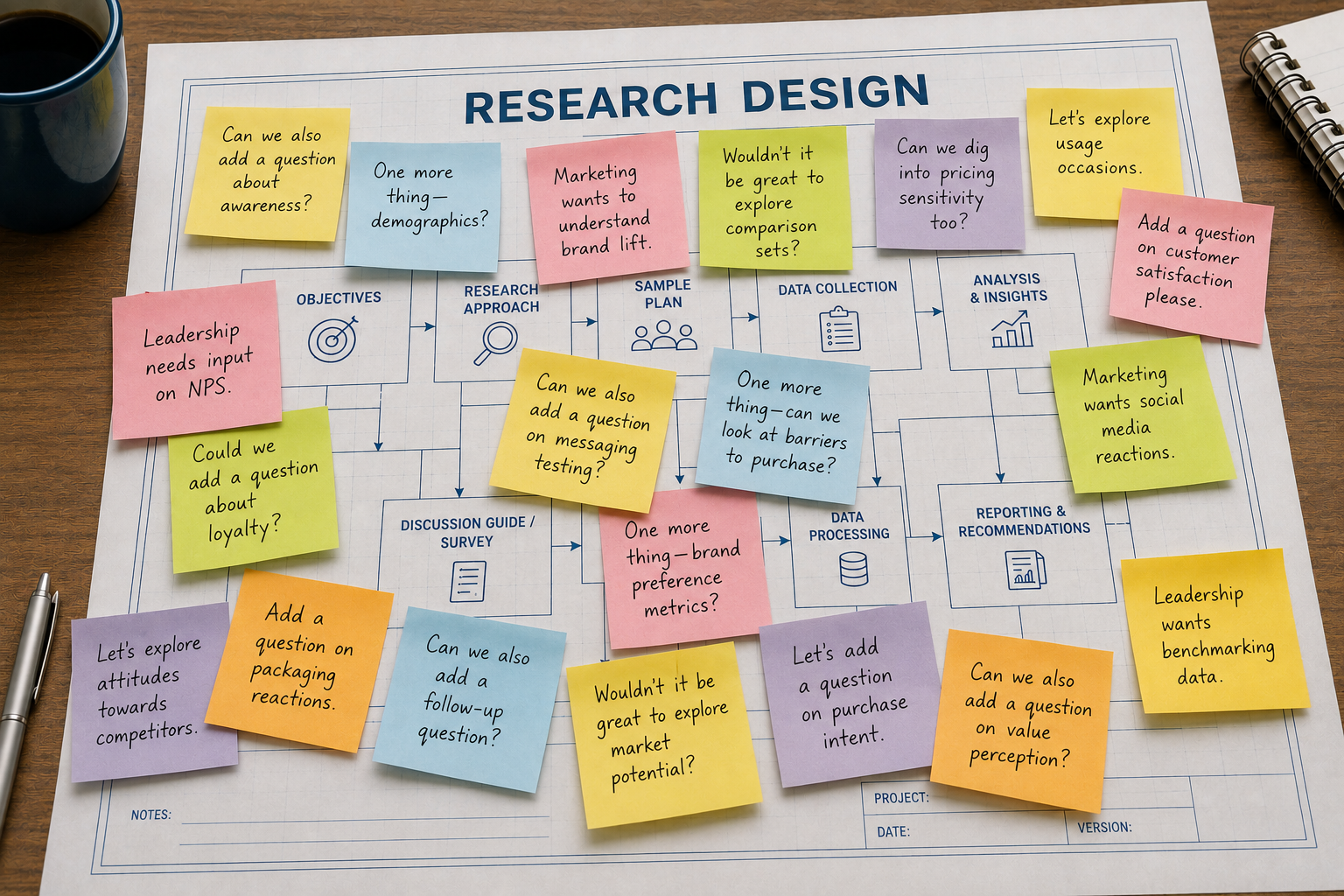
Even when the topics are not overtly conflicting, the cognitive load increases. Participants are being asked to do more within the same time frame, often without the space to fully process each line of questioning. Depth gives way to coverage. The study accumulates inputs but loses coherence.
For the research team, the cost shows up in focus. Moderators must juggle multiple objectives, each competing for attention. Survey design becoming fragmented and thinning coverage of critical topics to make way for fishing expeditions. Analysis becomes more complex as themes overlap, intersect, or pull in different directions. Instead of a clear narrative, the output can begin to resemble a collection of partial answers.
An even greater risk is the illusion of insight.
When questions are added as a bolt-on to an unrelated study, the answers they generate can appear meaningful simply because they exist. Stakeholders receive data and feel a sense of progress. Decisions get made. Yet the foundation supporting those decisions may be thin—responses gathered without the proper context, depth, or rigor to truly inform action.
In these cases, the danger goes beyond wasted effort and turns into misdirection.
Design: Intention over reflex
The challenge is not to eliminate complexity entirely. Research is rarely simple, and valuable insight often requires thoughtful design that goes beyond the obvious.
The challenge is to be intentional about when and why complications are introduced.
When multiple objectives are included, they should be connected in a way that supports, rather than disrupts, the participant experience. The transitions should feel natural, the context cumulative. Each addition should strengthen the study’s ability to answer its core questions, not compete with them.
When smaller, secondary questions are folded in, they should be approached with clarity about their limitations. Not every answer will carry the same weight, and not every insight should be treated as decision-ready. And a smart researcher can determine where and when in the conversation or survey these secondary questions can exist with the least amount of disruption and added bias.
And when creative approaches are introduced in pursuit of deeper understanding, they should be grounded in a clear hypothesis about what that complexity is intended to unlock. Novelty alone is not enough.
The discipline of restraint
One of the most underappreciated skills in research design is restraint. Knowing what not to include is as important as knowing what to pursue.
Every question added to a study comes at a cost. Time, attention, clarity, and analytical precision are all finite resources. Expanding the scope without expanding those resources forces tradeoffs, whether acknowledged or not.
The most effective research designs recognize those constraints and protect against unnecessary dilution. They prioritize depth where it matters most, even when it means leaving some questions unanswered.
Because in research, adding a little is rarely neutral. It either sharpens the work or erodes it.
The difference lies in whether that addition is treated as a deliberate design choice or a convenient afterthought.
JUSTIN SUTTON
CO-FOUNDER
CATAPULT INSIGHTS
Justin Sutton has led qualitative and mixed-method research programs for brands including retail, QSR, CPG, financial services, and durable goods organizations. His work focuses on behavioral drivers, innovation, Moments of Truth, and the intersection of System 1 and System 2 decision-making.