

At its best, research plays a dual role.
We are the voices of consumers, accurately representing their experiences, needs, frustrations, and motivations.
And we are the voices of truth inside organizations, helping stakeholders understand what research can and cannot responsibly say.
That second role is harder. And in today’s business environment, it’s becoming unavoidable.
Truth in research isn’t just about “getting it right”
Most research professionals are trained to protect the integrity of the data itself. We care deeply about representation, bias, methodological rigor, and ethical interpretation of what participants share with us.
But integrity doesn’t end there.
Truth also means helping stakeholders understand the boundaries of the work:
What this study was designed to answer
What it was not designed to answer
What kinds of conclusions the data can support—and where inference becomes speculation
In other words, research truth is as much about restraint as it is about insight.
The modern reality: more questions, fewer resources
No one in research needs reminding that the environment has changed.
Teams are being asked to answer more business questions than ever as the expectations and realities surrounding their businesses evolve. This may be faster product cycles, greater competitive pressure, more fragmented customer journeys, or higher-stakes decisions with less margin for error.
At the same time, research budgets and timelines are shrinking.
That imbalance creates a powerful temptation:
Can we just add one more question?
Can we bolt this onto the study we’re already running?
Can we stretch the data a little further to cover what leadership wants to know?
The intent is understandable. The consequences are not benign.
When “efficiency” breaks the research
Not every research design can answer every question. Some approaches are built to explore. Others are built to explain. Others to measure, validate, or prioritize.
Trying to collapse those goals into a single study rarely produces efficiency. More often, it produces ambiguity disguised as confidence.
We see this most clearly when:
Disparate stakeholder questions are tacked onto an existing study
Data are asked to support decisions they were never designed to inform
Findings are stretched beyond what the evidence can responsibly bear
The result is familiar and frustrating: garbage in, garbage out.
Except now, with AI tools to fill in the gaps, the output often looks polished enough that the underlying issues are easy to miss.
The hardest conversations researchers must have
This is where professional responsibility shows up. It’s not in the deck, but in the conversation.
Research professionals are increasingly being put in the position of having to say:
This study cannot answer that question.
We don’t have the right data to support that conclusion.
Answering that would require a different design.
I understand the need—but stretching the insight would make it unreliable.
These are not comfortable conversations. They can sound like friction. Or resistance. Or lack of commercial thinking. But avoiding them comes at a cost, both for the researcher and the organization.
The danger of stretching insight to please stakeholders
When research professionals feel pressure to deliver answers regardless of actual limitations, two things happen:
Truth erodes.
The distinction between insight and inference blurs. Context disappears and confidence increases—without evidence to support it.Credibility suffers over time.
Stakeholders may get the answers they want today, but the organization pays for it later through misaligned decisions, failed launches, or strategic whiplash.
This is one of the ways research loses its seat at the table. Not through irrelevance, but through over‑accommodation. Sadly, this is happening.
Protecting the right questions matters more than answering all of them
In resource‑constrained environments, research professionals add the most value by protecting what matters most rather than trying to answer everything.
That means:
Helping teams prioritize the key business questions that truly need rigorous answers
Designing work that is fit‑for‑purpose, not fit‑for‑everything
Being explicit about tradeoffs rather than pretending they don’t exist
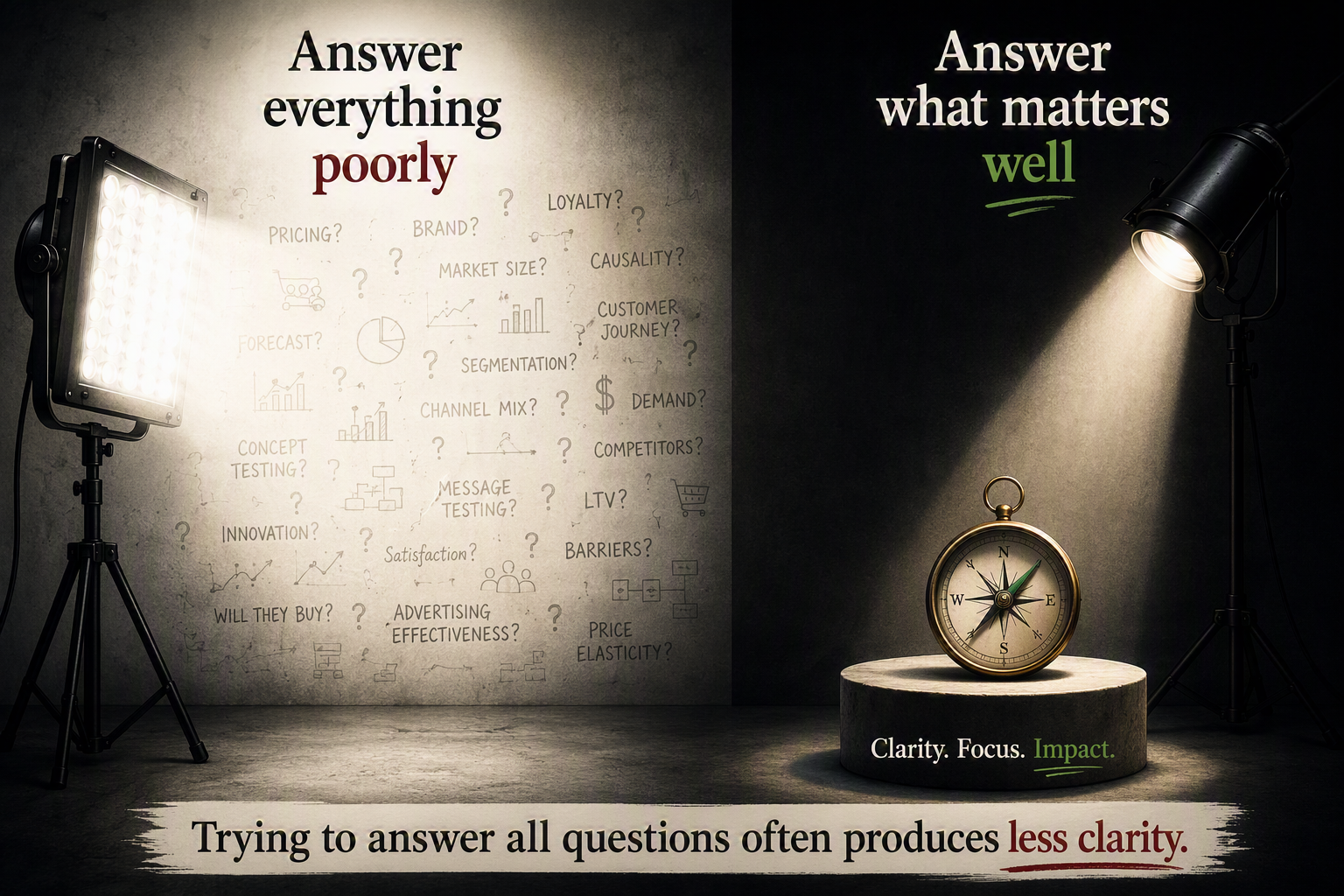
I recently heard a client-side researcher say this:
“We can answer this well—or we can answer ten things poorly. We can’t do both.”
That is not obstructionism. That is stewardship. And everyone’s respect for this researcher increased in that moment. Where others were trying to search with a floodlight, this researcher aptly knew that a spotlight was the best tool for the job.
The role of courage in modern research
Being the voice of truth requires more than methodological skill. It requires courage.
Courage to:
Push back when efficiency undermines validity
Educate stakeholders about design limitations without sounding dismissive
Hold the line when the data simply doesn’t support the story people want to tell
Know when to flex and when to hold firm
This isn’t about being precious with methodology. It’s about protecting decision‑making from false certainty.
What organizations actually need from research leaders
In a world of accelerating tools, shrinking budgets, and rising complexity, organizations don’t need researchers who say “yes” to everything.
They need researchers who understand the difference between insight and speculation, because articulating what research can responsibly deliver could become a lost art if we aren't careful. As researchers, it's incumbent upon us to act as translators between business ambition and methodological reality.
Most of all, modern organizations need research professionals willing to be accountable not just for what gets said, but for what shouldn’t be said at all.
Because real trust in research isn’t built when we always have an answer.
It’s built when stakeholders believe the answers we do give them are worth acting on.
JUSTIN SUTTON
CO-FOUNDER
CATAPULT INSIGHTS
Justin Sutton has led qualitative and mixed-method research programs for brands including retail, QSR, CPG, financial services, and durable goods organizations. His work focuses on behavioral drivers, innovation, Moments of Truth, and the intersection of System 1 and System 2 decision-making.