

Qualitative research has always been easy to misuse.
It works with fewer respondents. It embraces ambiguity. It deals in stories, emotion, contradiction, and context rather than statistics and significance. When done well, it is one of the most powerful tools organizations have for understanding people. When done poorly, it can quietly justify almost any conclusion someone already wants to believe.
The problem may not be new, but Generative AI is certainly accelerating it.
And right now, many are sleepwalking into a version of qualitative practice that looks efficient, polished, and decisive—while stripping away the very rigor and humanity that make qualitative insight valuable in the first place.
Qualitative research is not “small quant”

Many researchers are trained primarily in quantitative methods. That training develops a healthy respect for sample size, statistical confidence, and generalizability. Those instincts are appropriate and necessary when measuring how much, how often, or how many.
But qualitative research is not a lightweight version of quant. It is a different discipline entirely.
Qual specializes in interpretation. It requires comfort with partial answers, with people contradicting themselves, with truths that only emerge when you sit in the tension rather than rushing to resolution. It requires the ability to distinguish between what people say, what they do, what they feel, and what they cannot easily explain about themselves. It demands humility about what a small number of voices can and cannot represent.
This is why qual is difficult. And this is why AI is so seductive.
The original sins of qualitative work
Even before AI entered the picture, qualitative research came with well-known risks:
Over-weighting too few voices.
A small sample can illuminate patterns—but it can also amplify idiosyncrasy.Taking self-report at face value.
Not because people are lying, but because bias, habit, emotion, and social context shape how people explain themselves.Mistaking articulate respondents for representative ones.
The clearest storyteller is often the most confident narrator, not necessarily the most common experience.Treating themes like conclusions.
Good qual surfaces hypotheses and tensions. It rarely produces airtight answers on its own.
These risks require judgment, experience, and methodological discipline to manage. They require a researcher who knows when to slow down rather than speed up.
AI pushes in the opposite direction.
What AI changes, and why that’s dangerous
Generative AI is exceptionally good at one thing: making language sound finished.
That strength becomes a liability in qualitative work.
When AI is asked to summarize, tighten, synthesize, or “clean up” qualitative insights, several things tend to happen:
Context is compressed away.
The qualifying language—in this situation, for these people, under these conditions—quietly disappears.Gaps are filled with assumption.
When the data is thin or ambiguous, AI doesn’t stop. It completes the pattern anyway.Contradictions are resolved prematurely.
Messy, unresolved tensions—the very places where insight lives—are smoothed into coherence.Confidence replaces caution.
The tone sounds authoritative even when the underlying evidence is fragile.
In the hands of a researcher deeply trained in qualitative interpretation, these outputs can be interrogated and corrected. In the hands of someone who isn’t, AI’s confidence becomes a form of borrowed authority. It's merely a copy of a copy of a copy, and important details can be lost.
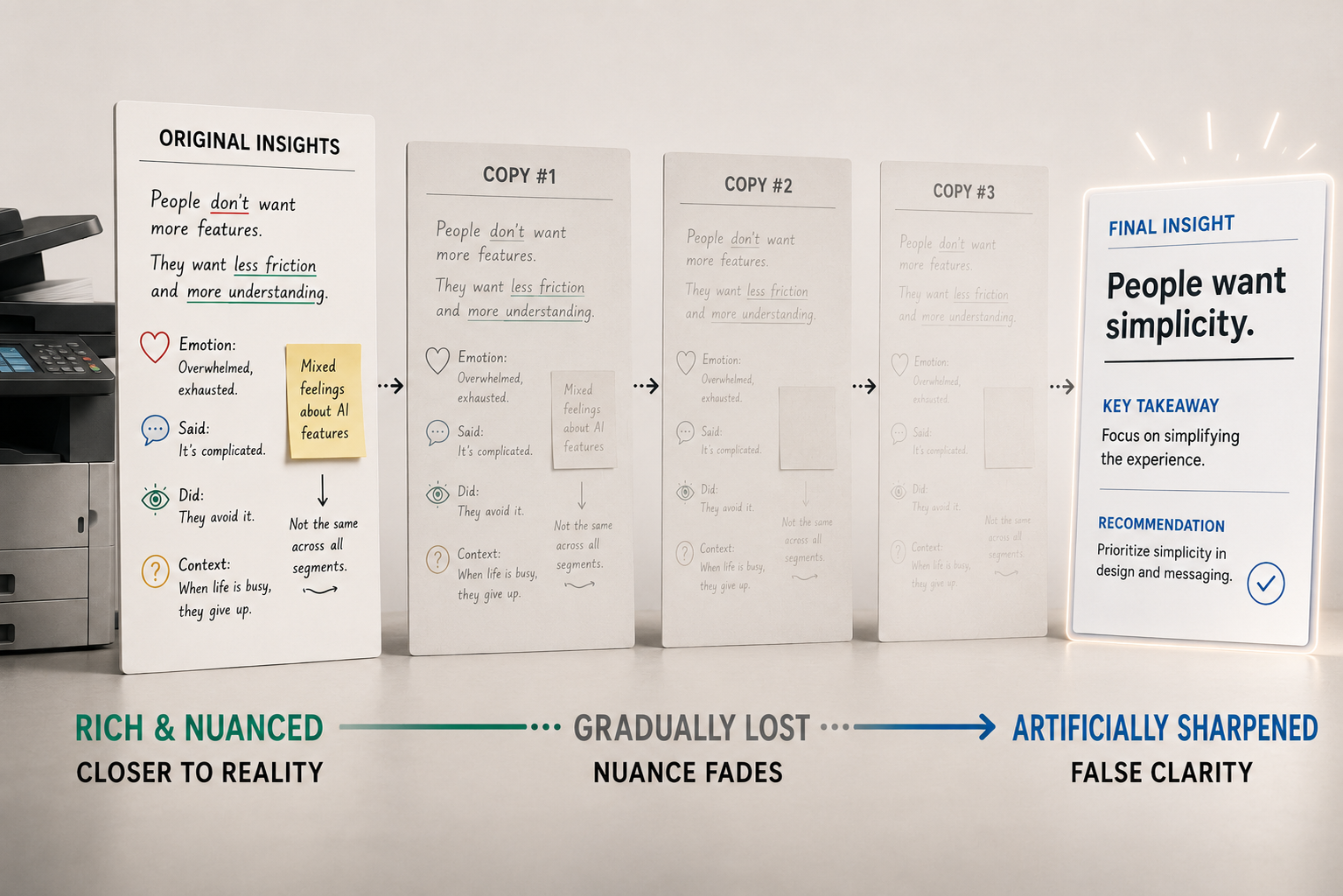
Pair this with organizations pushing for more efficiency and output with fewer resources – that’s where teams go over their skis.
When clarity becomes erasure
I’ve watched organizations grow increasingly confident in AI-shaped qualitative insights. Not because the research got better, but because the language got tighter.
Insights are fed back into AI, again and again, with prompts like make this more concise, make this sharper, make this more executive-friendly. Each pass strips away a little more context, a little more uncertainty, a little more humanity.
Eventually, the insight still sounds smart, but it no longer reflects the lived realities that produced it.
This is where Ted Chiang’s warning cuts uncomfortably close:
“The task that generative A.I. has been most successful at is lowering our expectations… It is a fundamentally dehumanizing technology because it treats us as less than what we are: creators and apprehenders of meaning. It reduces the amount of intention in the world.”
Qualitative research is an act of intention. It is meaning-making, not data polish. When AI is used to erase intention in favor of efficiency, we don’t just weaken insights—we dehumanize the work itself.
The professional risk no one is talking about
There’s another consequence that worries me even more.
Young researchers are learning that speed and confidence matter more than discernment. That insight is something you extract quickly rather than cultivate carefully. That AI can replace the uncomfortable work of sitting with and sharing partial truths with stakeholders.
That’s not just bad research. That’s a career risk.
Qualitative expertise is built by wrestling with ambiguity, not bypassing it. When AI becomes a shortcut around that struggle, we’re hollowing out the next generation instead of sharpening their skills.
And organizations feel the downstream effects: shallow insights, overconfident decisions, and growing distance between brands and the people they claim to serve. Stock prices are the next to follow.
The real alternative isn’t anti-AI—it’s pro-craft
You’re probably thinking I was going to say AI has no place in research – au contraire! The answer isn’t to reject AI outright. It’s to restore proper boundaries.
AI can (and does!) assist qualitative work, but it cannot be the analyst of record. It can retrieve, cluster, and draft. It cannot replace judgment, reflexivity, and methodological responsibility.
Most importantly, AI should not be used to resolve uncertainty. Its role is to help us see where uncertainty remains.
The strongest organizations will not be the ones that move fastest with AI. They’ll be the ones that know when not to trust it.
They’ll invest in qualitative specialists instead of retrofitting quant researchers with the wrong tools, protect context instead of compressing it away, and treat insight as a responsibility, not a shortcut.
Because in qualitative research, especially now, confidence is cheap, but understanding is not.
JUSTIN SUTTON
CO-FOUNDER
CATAPULT INSIGHTS
Justin Sutton has led qualitative and mixed-method research programs for brands including retail, QSR, CPG, financial services, and durable goods organizations. His work focuses on behavioral drivers, innovation, Moments of Truth, and the intersection of System 1 and System 2 decision-making.