

I've been thinking a lot about empathy lately, partly because it feels increasingly absent from places where it should be most abundant. Not because people have suddenly stopped caring, but because the conditions required for empathy to develop have become harder and harder to create.
Most of us are operating in environments that reward speed. We have more information to process, more stakeholders to satisfy, more meetings to attend, and more pressure to quickly arrive at answers than at any point I can remember. At the same time, AI has made it remarkably easy to summarize, condense, and synthesize information into neatly packaged conclusions. Taken together, these forces create a subtle but important risk: we begin mistaking exposure for understanding.
Simply hearing someone describe an experience does not mean we understand it. Understanding itself is a deeper accomplishment than we often acknowledge, requiring us to absorb not only what happened, but why it mattered, what emotions accompanied it, what tradeoffs were involved, and how it fits into the broader context of a person's life. Empathy sits even further downstream. It emerges when another person's reality starts to feel real enough that we can meaningfully appreciate how the world looks from their perspective, even when we have never lived that experience ourselves.
The path is not particularly complicated. We listen. We understand. We empathize.

What is complicated is that each step requires time, and time is precisely what modern organizations seem to have less of every year.
Lessons From Innovation
One of the more interesting lessons I've learned through innovation work is that the people who create the most meaningful solutions are often solving problems they don't personally have. I've watched healthy people develop products for patients living with chronic conditions, financially secure executives design solutions for struggling consumers, and teams of young professionals create experiences for retirees whose lives look nothing like their own. Shared experience was rarely the thing that made those efforts successful.
What mattered was their willingness to spend enough time understanding lives that differed from their own.
The most effective innovators I've worked with possess a kind of curiosity that borders on obsession. They want to know not only what people do, but why they do it. They become fascinated by routines, workarounds, frustrations, anxieties, aspirations, and seemingly insignificant moments that outsiders would normally overlook. What begins as observation gradually evolves into understanding, and what begins as understanding eventually becomes empathy.
That evolution is important because solving problems for people becomes extraordinarily difficult when you fail to empathize with them.
You can understand that a caregiver has responsibilities. You can understand that someone living with chronic pain experiences discomfort. You can understand that a frontline employee encounters friction throughout their day. But until you appreciate the emotional weight of those experiences, until you begin to understand what they feel like and what they mean to the people living them, your solutions are likely to remain shallow. The facts may be correct, but the understanding remains incomplete.
This concern has been sitting underneath much of my recent writing.
The Research Lens
In Falling into the AI + Qual Trap, I wrote about how AI is remarkably capable of making information feel finished. It can summarize a transcript, synthesize themes, tighten language, and generate compelling narratives with extraordinary speed. Yet qualitative work has never been fundamentally about organizing information. It has always been about interpretation. The danger is not simply that AI gets things wrong. The danger is that it encourages us to move from listening to conclusions before we've spent enough time wrestling with ambiguity, contradiction, and context.
Similarly, in From Truth to Trust, I argued that trust erodes when nuance gets compressed away and certainty expands beyond what the evidence can reasonably support. Both ideas are connected by the same underlying concern. We are becoming incredibly efficient at processing information while simultaneously becoming less patient with the processes that transform information into genuine understanding.
Empathy often becomes collateral damage.
Every summary removes a little context. Every synthesis simplifies complexity. Every effort to make information cleaner and easier to consume creates a little more distance between us and the people who generated the data in the first place. None of these actions are inherently wrong. In fact, many are necessary. But when every incentive in the system points toward speed, efficiency, and brevity, it's worth asking whether we are unintentionally stripping away some of the very things that help us understand people most deeply.
This is one of the reasons I continue to believe qualitative research remains so valuable. At its best, it creates the opportunity for empathy to develop. Not because empathy appears automatically whenever we conduct an interview or observe a consumer, but because these methods create something increasingly rare: space.
Space to allow curiosity, contradictions, and reflection. Stories are told in this space, and ultimately, empathy is allowed to grow roots.
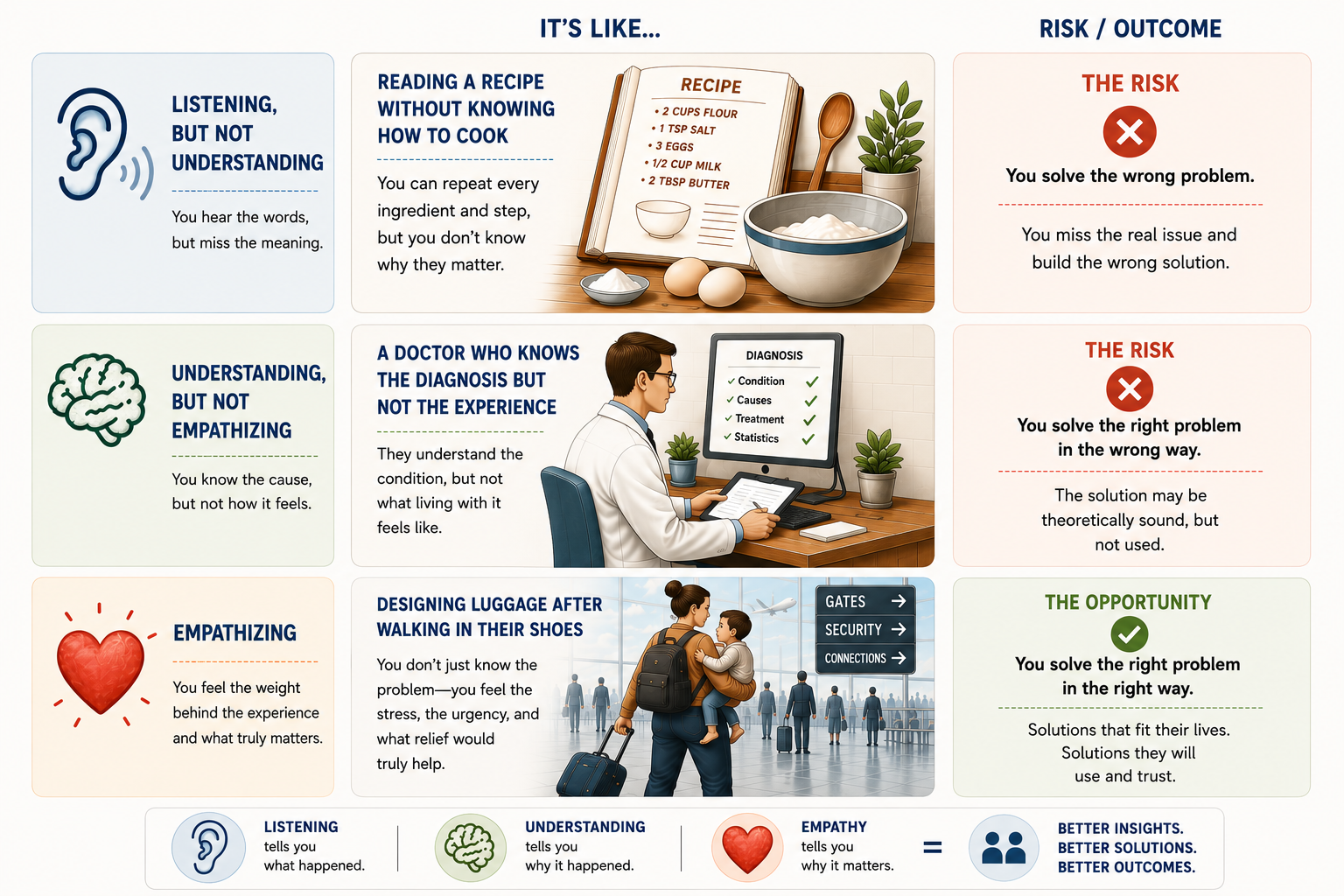
Organizations that consistently create products, services, and experiences people genuinely love have always been the ones willing to spend more time appreciating the realities of the people they serve. The future competitive advantage will belong to those who remain disciplined, slow down long enough for understanding to develop, and practice patience that allows that understanding to mature into empathy. Not to those who can process information the fastest.
Because if innovation has taught me anything over the years, it's that you don't need to share someone's circumstances to solve their problems. You do, however, need to care enough to understand their world. And in a time increasingly optimized for speed, I find too often that depth and patience are becoming choices.
So is empathy.
JUSTIN SUTTON
CO-FOUNDER
CATAPULT INSIGHTS
Justin Sutton has led qualitative and mixed-method research programs for brands including retail, QSR, CPG, financial services, and durable goods organizations. His work focuses on behavioral drivers, innovation, Moments of Truth, and the intersection of System 1 and System 2 decision-making.